Arrests for driving while intoxicated have more than halved in Austin over the last 12 years, according to data from the Austin Police Department. Ride-hailing services, like Uber and Lyft, have likely contributed to the decline, but it also comes from a lack of enforcement by APD.
When did ride-hailing start?
Ride-hailing started in Austin around June 2014.
Austin originally tried to regulate ride-hailing companies like Uber and Lyft, which led to their temporary exit from the market. Other companies, like RideAustin, filled in the market gap during that time. Uber and Lyft eventually came back in May 2017 after Texas Gov. Greg Abbott signed a measure into law that superseded city and county ordinances.
What happened to APD’s enforcement?
Back in 1998, the Austin Police Department started the DWI Enforcement Unit. At its height, the unit had three sergeants, three corporals and 20 officers, according to Sgt. Ryan Huling, who began supervising the unit in 2018.
The officers would go out on the streets, conduct traffic stops and help other patrol officers with DWI crashes.
But that all changed in 2020 and 2021, when the Austin Police Department restructured. The police officers on the DWI Enforcement Unit were shifted to patrol, and it was disbanded. The unit was replaced by the Impaired Investigations Unit, which Huling oversees. The new unit only has three full-time detectives.
“When you no longer have full-time enforcement, you just are gonna see a reduction in arrests,” Huling said. “When we talk about the decline of numbers, we’re talking about the decline of arrests.”
Huling said the numbers are hard to quantify.
“There’s just no way to know how many fewer, if any, actual impaired drivers are out there. The only thing we can gauge is how many of them have been arrested,” Huling said.
He said that the number of impaired drivers arrested on any given night depends on how many officers there are to make DWI stops.
DWIs are categorized into three sections: crashes, traffic stops and other, Huling said. The number of DWI arrests coming from crashes grew while the number of arrests coming from traffic stops, a more preventative measure, decreased, according to Huling.
The reduced enforcement is also complicating another aspect of the police department’s fight against drunk driving: messaging.
“We did meet with some folks who had been arrested for DWIs in the past and sort of had some insight into these types of things,” Huling said. “There was rumblings that they knew that they could probably go out and be less likely to be caught [driving while intoxicated] during that time because there’s a lack of actual full-time DWI enforcement.”
How has ride-hailing affected Austin’s DWI arrests?
Publicly available data on the impact ride-hailing has had on impaired driving is limited in Texas. That’s because in the measure Gov. Abbott signed, companies like Uber and Lyft weren’t required to share data, like the number of rides completed, prices, and dates or times of rides.
“61% use Lyft to find a rideshare driver when they are planning to drink alcohol or use another substance that could impair their driving ability,” according to the report.
Lyft also stated that ride-hailing was correlated with a 7.5% decrease in impaired driving in Fort Worth, Texas, according to the company’s 2025 economic impact report.
Uber did not respond to requests for comment or data.
‘A small but meaningful impact’
The police department and the city of Austin also work closely to reduce drunk driving.
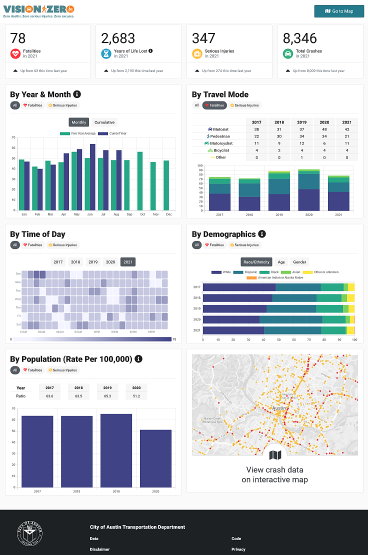
Austin’s Transportation and Public Works department has an ambitious goal called “Vision Zero” — or zero deaths and serious injuries on the city’s roads.
Joel Meyer, a transportation safety officer with Vision Zero, said the department sends monthly reports to APD sector commanders of where the crash hotspots are around the city. It helps the police department have proactive enforcement in those areas, Meyer said.
“We haven’t done an Austin-specific study on the impact of ride-sharing services, but I think the overall trend we’re seeing is that it has made a small but meaningful impact,” Meyer said.
There are also Austin-based researchers like Kara Kockelman, a professor at the University of Texas’ Cockrell School of Engineering.
Kockelman’s research, co-authored with Priyanka Paithankar and Krishna Murthy Gurumurthy, has shown that pickups for rides in New York City tend to be higher on Friday and Saturday nights as well as very early Saturday and Sunday morning, when people are coming back from bars.
Kockelman’s research focuses on traffic safety, among other things. She said that the large vehicles in the United States have led to more reckless driving. “We have all these very inefficient heavy vehicles that weigh, maybe 100 times more than the contents that they were really trying to move around?” Kockelman said. “It’s pretty obscene. And I think that means there’s no skin in the game for the driver and the occupants.”
How is Austin trying to prevent drunk driving?
The city of Austin expanded its “no refusal” program to be year-round from 9 p.m. to 5 a.m., according to Huling. That means anyone suspected of drunk driving cannot refuse a sobriety test.
Austin’s Transportation and Public Works department also launched “Get Home Safely.” It’s a page dedicated to helping people in Austin find a way to get home after a night out of drinking.
One of the features included is the Parking Ticket Waiver Program. If a person drove to a bar and left the car in a city parking space, the person can submit the ticket and a receipt of the rideshare to have it waived.
CapMetro’s night owl buses also run from midnight to 3 a.m., according to the agency’s website.